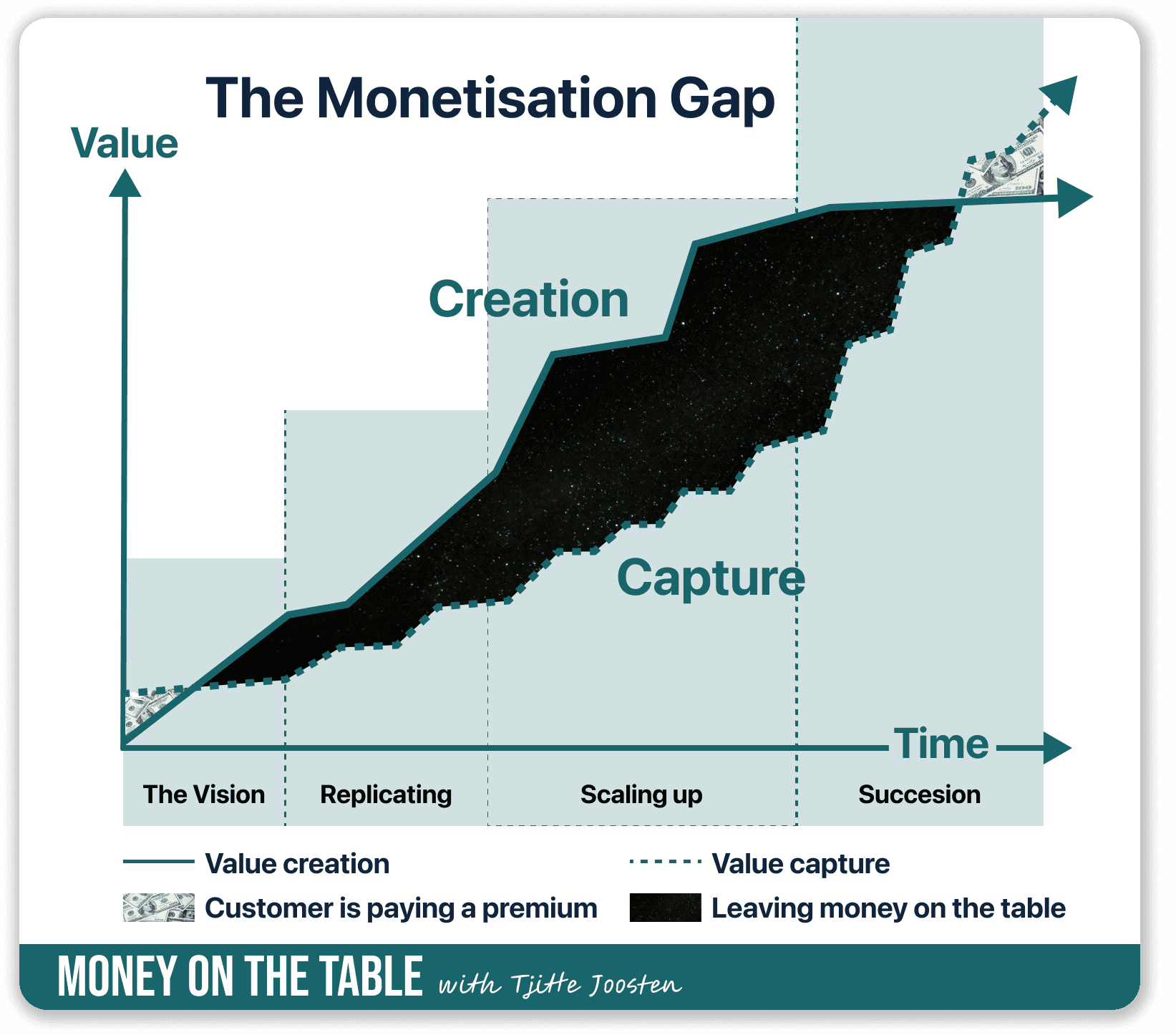
Most of what I’ve published to date is about how to apply specific tactics to avoid leaving money on the table. Today, however, I want to zoom out and share how most companies are systematically leaving money on the table throughout their lifecycle.
My initial motivation to write this article was to visualise the Monetisation Gap with the sole goal of making it tangible for others how much money companies generally leave on the table.
While working on it, however, it became abundantly clear to me that mistakes in the early stages of a company have far-reaching and outsized consequences later on. I’m hoping readers will be motivated to start thinking about pricing earlier in the journey after reading this.
It’s not a quick read, so I recommend bookmarking it and continue reading when it’s most relevant.
Disclaimer: this framework is of course a simplification and generalisation of the typical pricing journey of a software company, individual cases may deviate.
👋 Hi, it’s Tjitte Joosten and welcome to Money on the Table, your #1 source for making sense of pricing and packaging. Subscribe to get posts like this delivered straight to your inbox.
1. The Hypothesis (TL;DR)
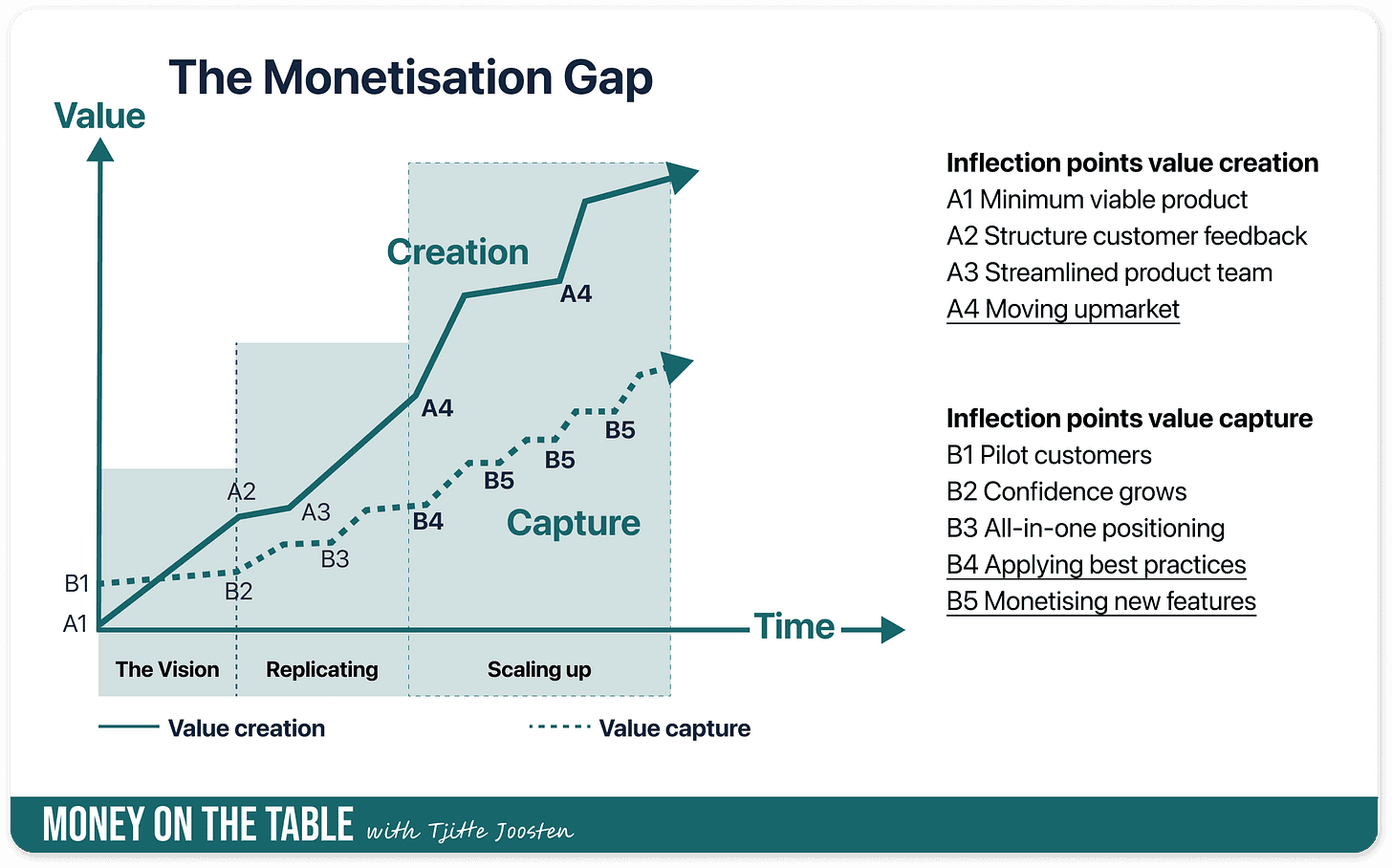
The framework below visualises the gap between the abilities of a company (1) to create value and (2) to capture that value, over time. As you can see, as time progresses, companies struggle more and more to capture the value they create for their customers.
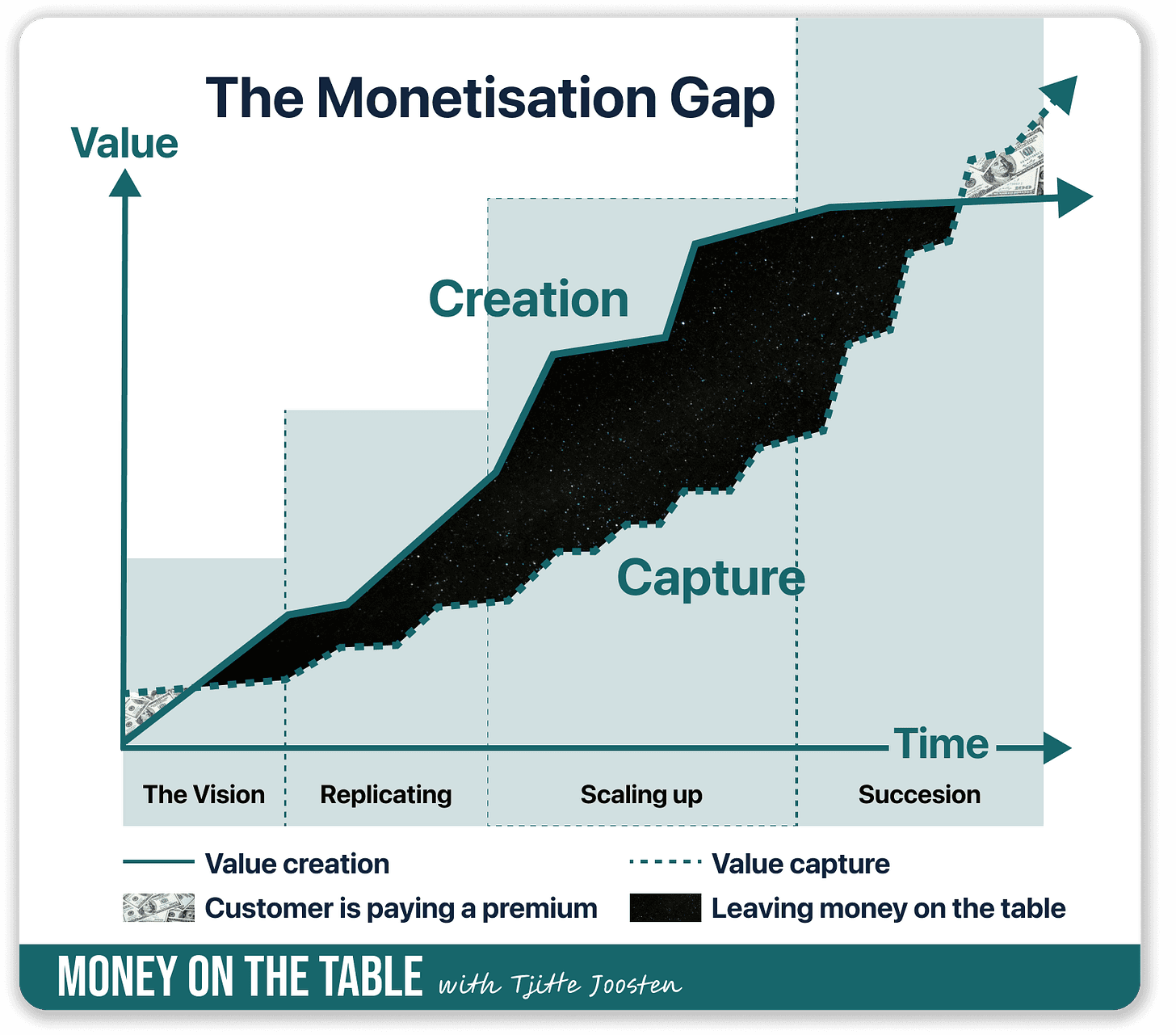
In other words, companies are systematically leaving more money on the table as they grow. This struggle can impede growth rates or deepen reliance on external capital.
My hypothesis: the widening of the Monetisation Gap over time is mainly due to mistakes made in the early days, but this trend is, in fact, not inevitable.
For the purpose of this story, we can divide the lifecycle of a company into four distinct phases each marked by specific events, milestones, and a frame of mind:
The Vision: selling the vision rather than the actual capabilities.
Replicating: establishing product-market fit.
Scaling Up: accelerating growth and moving upmarket.
Succession: transition of ownership and incentives.
I could dedicate an entire book to the phenomenon of the Monetisation Gap, but to keep this manageable I will focus on the main events and inflection points. Each inflection point is notated chronologically and represented in the visuals (A for value creation and B for value capturing).
In the first chapter I share a brief description of each phase and the core inflection points. The second chapter highlights the most important causes of the widening Monetisation Gap in each phase. Finally, I will share what you can do to mitigate the effect of these causes.
“This trend is, in fact, not inevitable.”
2.1. The Vision: Inception
The best companies start out by selling a product long before it’s even ready.
In those early days, the product is riddled with bugs and it’s even doubtful whether it solves the problem. But real entrepreneurs, armed with nothing but a slide deck and a passion for the problem, can sell customers on the vision.
At this stage, (B1) every dollar your customer pays (value captured) is arguably one too many considering the problem they want solved isn’t actually solved. Luckily, some believe you can build the solution to their problem. And since their problem is painful enough, they’ll take a risk on you.
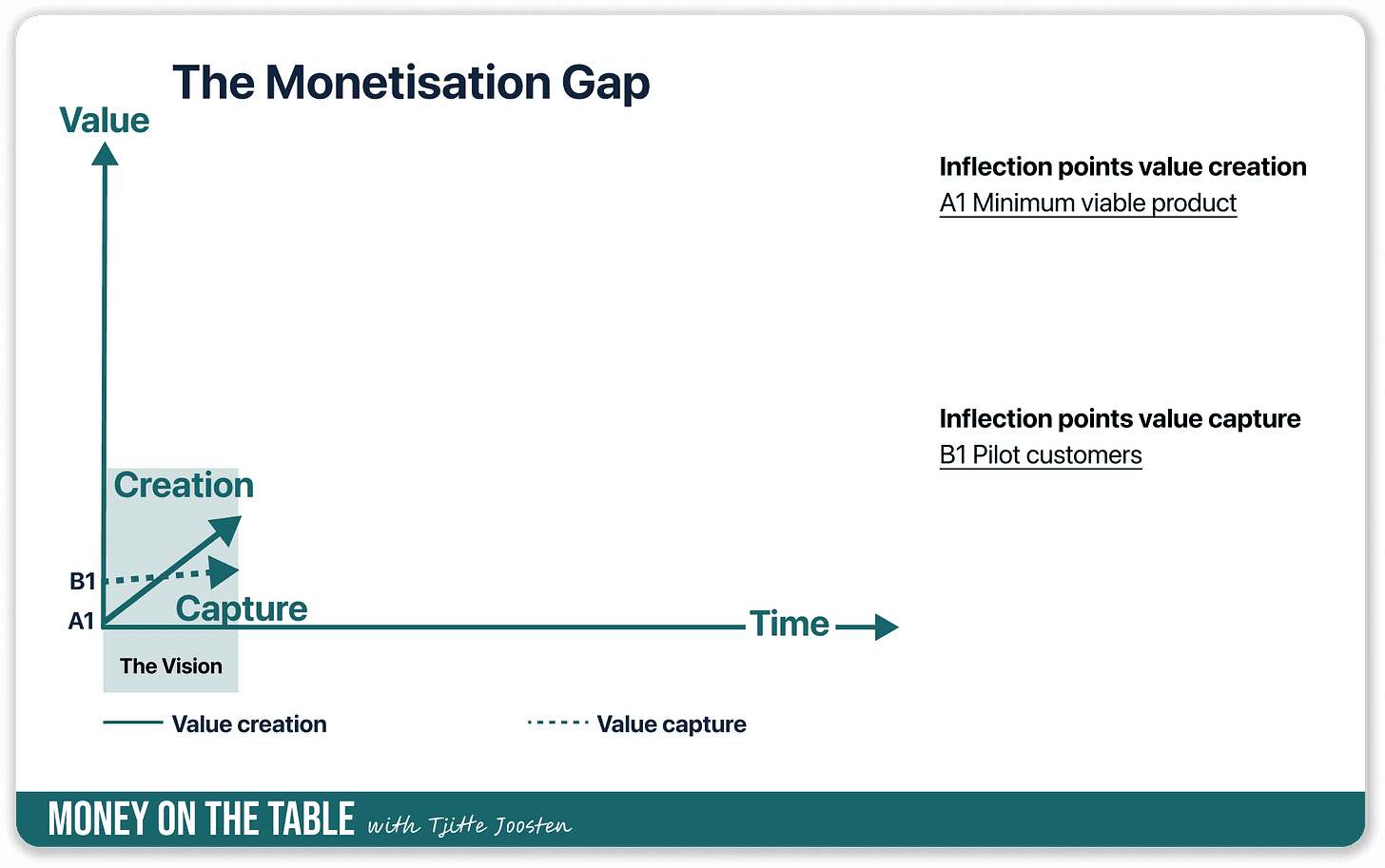
Plenty of startups never make it out of this phase, because it may take more time and money to build the solution than customers are willing to invest. But those who can deliver on their promise in time (A1) start creating value for their customers.
The real validation comes in when the first customers are willing to go beyond a pilot phase or renew their initial contract. That’s when you move to the next phase ‘Replicating’.
2.2. Replicating: The Gap Widens
So, you’re starting to solve a problem and have the first committed clients. Now it’s time to find out whether it was a fluke or whether there is a real market for your solution.
That means you have two objectives in this phase:
Move from a tailored to a universal solution.
Learn how to position and sell.
Replicating the product
As you transition into phase two, you have to learn how to synthesise customer feedback. You can no longer afford to fixate on just one or two customers. You have to collect input from dozens, discover patterns, and prioritise features that solve problems for a larger segment.
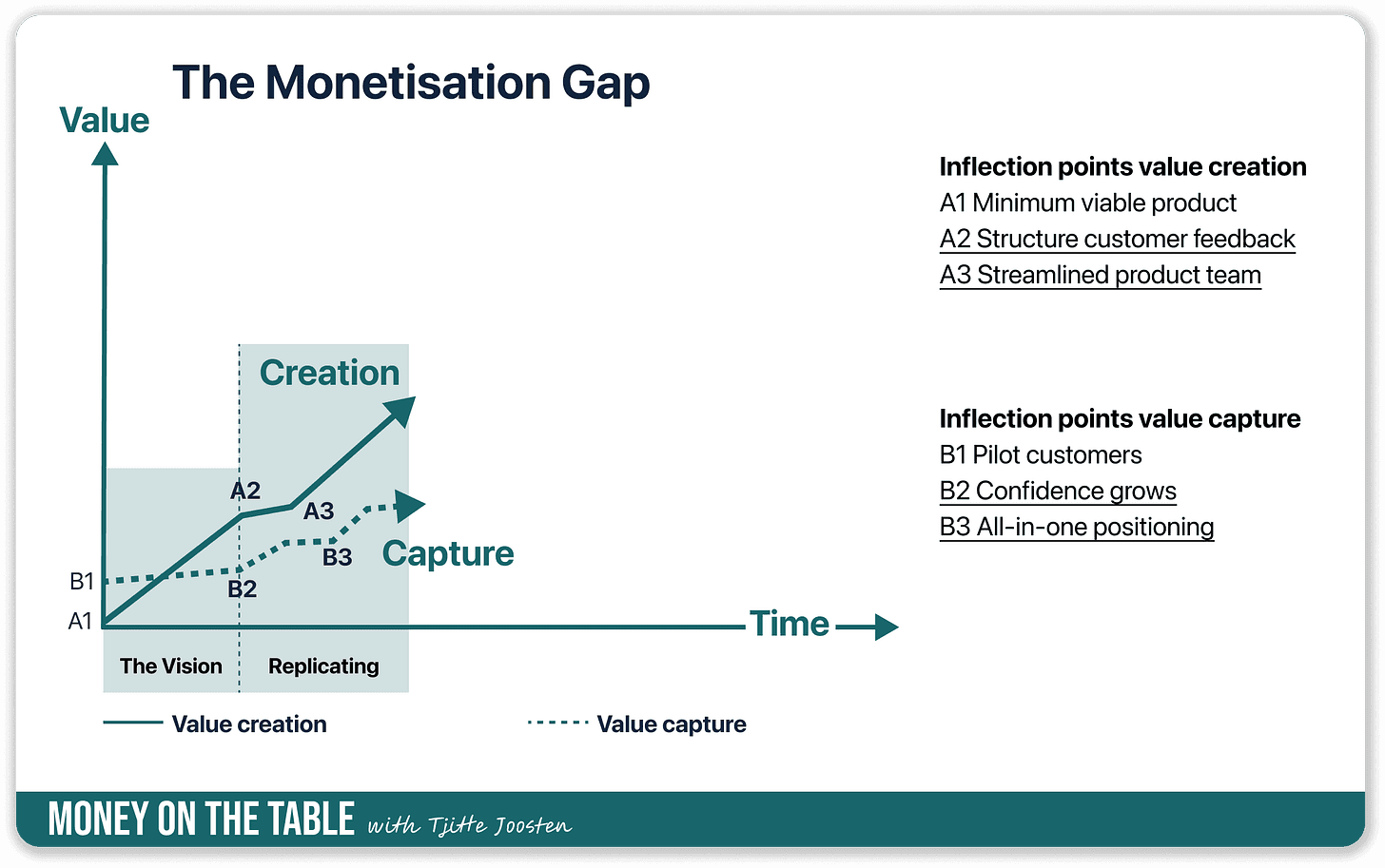
In terms of value creation, this means your product team will (A2) initially slow down to organise this process. But once it’s in place, (A3) you’ll catapult your ability to ship useful functionalities.
Replicating the go-to-market (GTM)
Parallel to building a replicable product, you have to design a replicable GTM motion. Meaning, you have to learn how to position and sell your product. What problem you claim to solve and how (positioning) will determine how you sell and price the product.
Most startups tend to hedge their bets at this stage. They decide to go with two or three problems they see in the market rather than laser focus on one key problem. They end up trying to sell a Swiss knife, when all their customer wants is a corkscrew.
This leads to two key inflection points on the value capture curve. First, after closing a few deals, (B2) most Founders simply feel more confident and charge 20–30% more. Second, (B3) companies that position themselves as an all-in-one solution (albeit a very basic one) tend to add another 20–40% to the price tag.
Once you’ve completed both objectives, you’ve found product-market fit and your solution is now sticky enough to scale up.
2.3. Scaling Up: From Gap to Chasm
As you transition into phase three, you’re moving from validating to scaling. You have a rudimentary understanding of your unit economics and a rough estimation of what every euro spent gets you.
Now it’s time to improve those economics and start scaling your product delivery, commercial operations, and ironically your Monetisation Gap as well.
There are two defining characteristics of this phase from the perspective of monetisation:
Organisations become obsessed over the unit economics
Moving upmarket
Unit economics
You’ve clearly validated a need and found a market, but the question remains: can you service this market profitably? In order for that to happen, you want to increase the return for every euro spent while also reducing cost by achieving economies of scale.
Hence, you start measuring. And soon you realise, your power users are paying way too little compared to the value they’re extracting. Considering doubling or tripling the price is rarely a popular idea, you look for more creative measures. (B4) You start introducing usage limits, additional seats, new packaging tiers, premium service. Little by little you’re expanding the average deal size and capture more value.
Finally, you ask yourself: what is the return on our product development? This leads to prioritising the roadmap based on opportunities to monetise. (B5) You release add-ons and craft more sophisticated pricing tiers.
Moving upmarket
As the product progresses you start attracting customers with more complex problems and deeper pockets. Initially, these tend to go unnoticed. Inevitably, however, thanks to a growing pool of customers and your data skills maturing, you catch on to this segment.
It leaves you with a choice: focus on high volume or move upmarket. Every software company arrives at this crossroads during the scaling phase. And almost every successful B2B SaaS company you can think of, has made the transition upmarket (multiple times).
Every time you (A4) move upmarket and unlock a higher segment, you leapfrog the value created as you’re solving more complex problems for more sophisticated buyers.
As you’re scaling, you’re rapidly reducing risk, capturing more market value, and becoming highly attractive to a different set of buyers: competitors and the capital markets. So, let’s talk about succession.
2.4. Succession: The Gap is Arbitraged
Hundreds of tech companies have IPO’d in the last decade. Alphabet, Apple, and Microsoft have acquired more than 100 companies each! Private equity firms focussed on acquiring and consolidating SaaS companies are popping out of the ground like mushrooms.
If you’re building a (profitable) high-growth tech company, chances are, someone is looking to buy you out. And while there are myriad reasons to buy your company, there is one undeniable fact of life: your Monetisation Gap is their arbitrage.
And with new owners come new incentives. The Founder’s vision might survive, but it’ll never outrank the new owners’ incentives. And while I cannot speak for the motivation behind every strategic merger, the capital markets are in the business of making money…
Innovation is now doomed to be contained within the boundaries of the Excel sheets. (A5) Radical changes become too risky and incremental “improvements” take the lead. Most companies will continue to invest in creating more value, but at a bureaucratic pace.
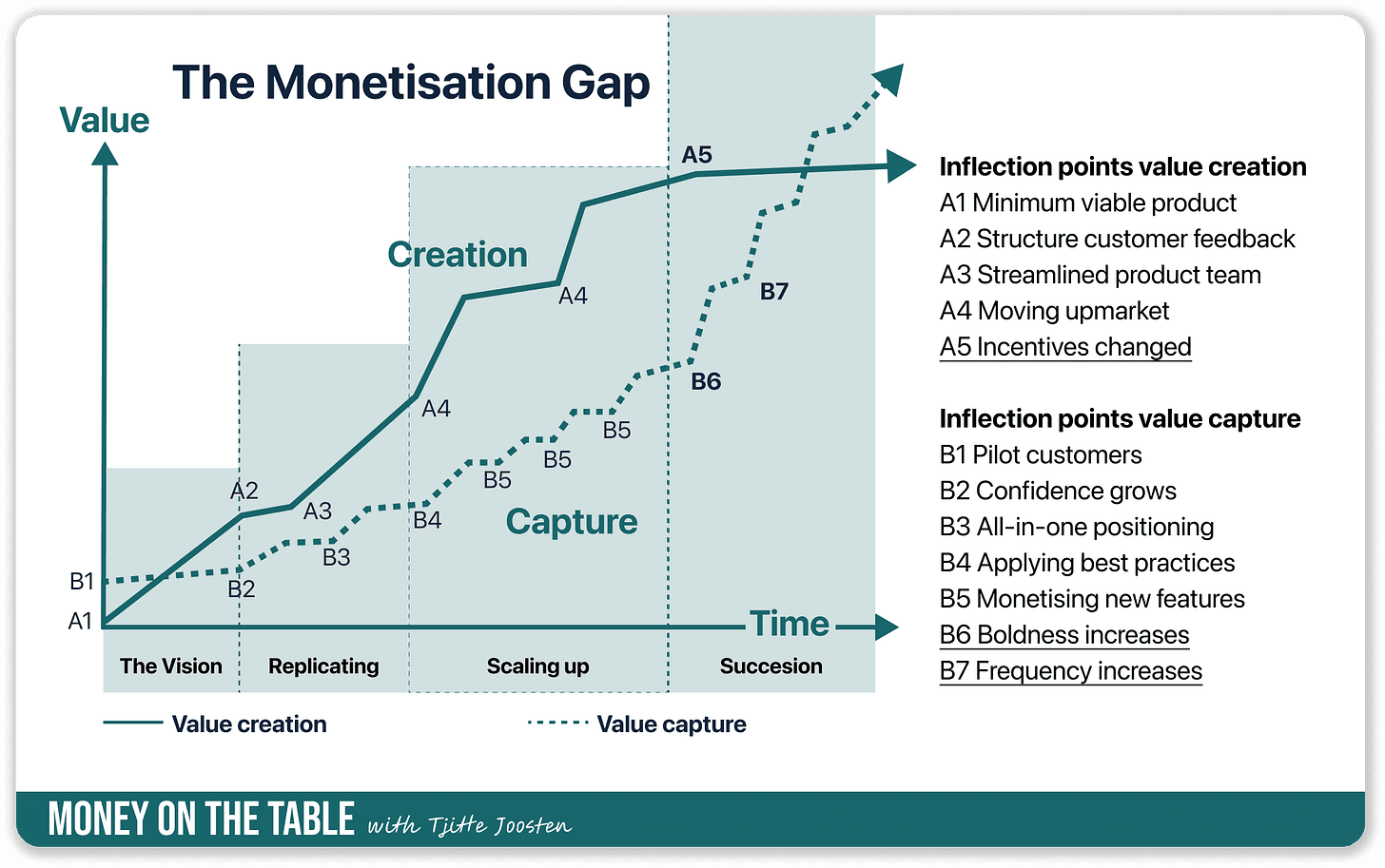
Meanwhile, pricing experts come in to mature the business and particularly the monetisation strategy. Both the (B6) boldness and the (B7) frequency of the price changes increase.
Slowly, the ability to capture value starts exceeding the value creation for the first time since The Vision phase. For years, clients enjoyed massively impactful product releases and rarely had to pay up. But now everything reverses, users can expect incremental changes paired with sharp price hikes.
Don’t believe me? Just ask ChatGPT for iPhone prices…
Important note: not every successful company is sold or goes public, but it holds true for many companies that a time comes when innovation stagnates and counter-intuitively prices go up.
“Your Monetisation Gap is their arbitrage.”
3. Catalysts
Now that I’ve shared how companies systematically leave money on the table, I want to zoom in on the why. What happens at each stage that causes the Monetisation Gap to widen or invert? I will limit myself to two catalysts per phase.
3.1 The Vision: Indebtedness and Guilt
There are many factors that impact the size of the future Monetisation Gap in this phase, but two stand out:
Indebtedness/gratitude: the emotion you feel towards clients willing to take a chance on you when no one else did. It’s human nature to reward these clients with a heavily discounted price.
Guilt: the longer it takes to deliver on your promise, the harder it’ll feel to negotiate a higher price in the future. It can take months or years to gain back the confidence to charge a premium price.
3.2 Replicating: Flying Blind
In order to accurately price your solution, you need to understand how much value you create for a segment. Problem is: you’re still trying to figure out which problem you’re solving. At this stage, every customer is telling a different story and cares for different functionality. And you simply don’t have enough customers to spot patterns. Meanwhile, when you price too high your customers or prospects will tell you. But it is extremely rare for anyone (during this phase) to tell you that you’re undercharging. You’re flying blind and all you can do now is keep experimenting while staying alive.
How do most startup Founders deal with this? They hedge their bets and focus on two or three key problems rather than just one. Often resulting in positioning as all-in-one solutions rather than specialisation. The problem is: if you solve a little of everything, you will probably charge too little for everything… People may pay you €100 for a Swiss knife today, but if you had taken your time you could’ve sold them all individual tools for a sum of €500.
3.3 Scaling Up: From Leaps to Steps
Maturing also means becoming more risk-averse. I see this all the time: as organisations start becoming obsessed over data and unit economics, they automatically gravitate towards incremental changes. They have a natural tendency to improve rather than reinvent. However, at this stage of the Monetisation Gap, a complete overhaul would be more fitting. Instead, organisations opt for introducing minor changes like new add-ons or updated plans. Which manager is willing to risk their career to do what is necessary?
And this is especially damaging when moving upmarket. But besides risk-aversion, there is a second reason most companies fail to get the most out of a move upmarket: entitlements. People simply become used to getting value X for price Y. If only Y changes and X stays the same, that can cause friction or even churn. That’s why preventing certain entitlement is so essential. Without the right value metrics, usage caps, or fair usage clause you’re bound to end up in a bad situation. For example, if you’re selling data and charging based on the number of seats, your most successful user might only need one license to get 100x more value than a client with 30 licenses.
3.4 Succession: Fresh Set of Eyes
All of a sudden the trend reverses. The gap is bridged and customers start paying a premium instead. The money is taken off the table.
The main reason private equity, public markets, or any new owner for that matter succeeds at closing the Monetisation Gap is an absence of emotional ties to the customers. They can approach this problem rationally. They simply do the math and conclude that existing customers are underpaying and that this must be reconciled.
So, from the lens of monetisation this is definitely the most successful phase. However, one might wonder at what cost? With the incentive to invest in real innovation and R&D removed, we see a growing trend of enshittification.1 Luckily, I’m also seeing more and more private equity firms that do allocate budget for continuous innovation.
Before we move onto strategies for dealing with these catalysts, I want to point out that the majority of them are psychological. Many still believe pricing is a math exercise executed in spreadsheets. However, the core skills of pricing are psychology and storytelling.
4. Breaking the Pattern
If you’re still reading this, it’s probably because you’re eager to find out how you can prevent or at least mitigate the impact of these catalysts. This deserves an entire article of its own, but for now I’ll share a few tips to get you going. Additionally, you can check out the rest of my Substack for more practical tips.
4.1 The Vision: Setting Aspirations
The only advice I can really offer to prevent guilt is to deliver as fast as you can while proactively managing expectations. I don’t think you can fully eliminate it, but being transparent goes a long way.
But far more important is the impact of indebtedness, as this will set you on a course to leaving a lot of money on the table. The price you charge those initial customers will forever anchor any future deal you close.
I won’t suggest to stop discounting early customers. Instead, I simply propose to make discounts explicit. Quantify the potential value of your product if it would work perfectly. Next, you simply apply a discount anywhere between 10% and 90% for it not being perfect yet and them taking a risk on you. I leave it up to you whether you want to communicate this discount with the customer or simply log for internal reference.
This way, your new anchoring point will be what your product is worth rather than what you charge those initial customers. This method has the added benefit of automatically lowering that discount as you become more confident in your product and the risk for new customers is diminishing.
4.2 Replicating: The Business Case
No matter what stage your company is at, it’s always a good practice to co-create a business case together with your customer (if ACV >5K). The goal of this exercise should be to determine the potential ROI of your solution. That means aligning on the problem, defining success, and quantifying the potential outcome (e.g. if you’re saving time, simply measure the # hours and multiply by the hourly wage of those involved). If you both agree on a number or a range, any price you present within 10–20% of that will seem reasonable. The added benefit from this exercise is that the value metric (i.e. seats, usage, outcomes) becomes self-evident. You can do this exercise for any B2B client, that way your pricing isn’t limited by the last deal you closed.
Founders are inherently optimistic. They have to be to start a company while the odds are against you… But that superpower is also a massive risk. Execution requires laser focus, and seeing opportunity around every corner slows you down. I think that’s essential for the overall business, but let’s stick to pricing. Companies that position themselves as the ultimate expert on one problem can charge a premium price. The best example of this is Superhuman. For those who don’t know, Superhuman is essentially an email wrapper. They charge ~$25/month/user to help you save a few hours per week on email. Gmail charges less than $10/month and includes an entire suite of other products! Better yet, you still need Gmail or Outlook to even use Superhuman. In case you think that could never succeed: Grammarly acquired Superhuman for approximately $825 million in 2025. The moral of the story: less is more.
4.3 Scaling Up
I already gave it away in the previous chapter, but at this point you probably need a reset rather than a few tweaks. No more Excel sheets, but a session at the white board. Pricing is positioning and vice versa. Everyone intuitively understands your messaging needs to change when moving upmarket, but few understand pricing breaks down as well. How value is created has changed, so how you capture it must change as well. As deal sizes increase, you should introduce more value metrics, more optionality, offer new service levels, and more. But you can’t just edit the existing story, you need to tell an entirely new one. Your best option might be to create a new tier or revamp the entire pricing strategy. You should even consider whether you still want to offer plans aimed at the bottom half of your customers.
But telling your existing customers you’ve decided they should be paying 300% more can be a little awkward. Especially if nothing fundamental is changing for them. So, how do you avoid this situation? By adopting fair usage clauses and usage limits early on. You don’t need to enforce these, but it gives you optionality. They don’t have to be accurate on day one and it’s possible to update these with renewals. The most important part: include something in the agreement that will give you a legal obligation to sit down with your power users.
4.4 Succession
As I stated in 2.4 and 3.4, the Monetisation Gap is finally bridged and the money is taken off the table. This can mainly be attributed to a fresh set of eyes and more aggressive monetisation policies. But that’s not what I want to focus on right now. Instead, I want you to reflect on everything I’ve written and then ask yourself: What would’ve happened to the company if the Monetisation Gap wasn’t there? Everything else being equal, what would the valuation have been if customers paid 2–3x as much? Would the company have needed to raise as much external capital during the journey as they did? Would the Founders and other shareholders have had a much larger payday?
It’s hard to tell, but what I do know for certain: right now entrepreneurs are leaving money on the table for someone else.
5. Conclusion
So, what are you supposed to take away from all of this?
I shared the following hypothesis at the start: the widening of the Monetisation Gap over time is mainly due to mistakes made in the early days, but this trend is, in fact, not inevitable.
I started by visualising the gap between the abilities of a company (1) to create value and (2) to capture that value, over time. It shows that, as time progresses, companies struggle increasingly to capture the value they create for their users.
It’s clearly not one single mistake that causes the Monetisation Gap. It’s a series of mistakes with a compounding effect and an inability to simply reset that leads to the widening gap. And due to the multiplying effect, the gap grows exponentially.
But I’ve also shared various suggestions on how to deal with the challenges of monetisation. Not every single mistake can be avoided. But most of catalysts can be mitigated and some can even be prevented entirely. Due to the compounding nature, preventing just one or two of the mistakes can sometimes already reduce the gap by 50%.
In other words: it’s never too late to revisit your pricing strategy, but the earlier you start thinking about pricing the better.
Want to learn more about SaaS pricing and packaging? Subscribe to Money on the Table or schedule a call at https://revfixr.com/contact

Tjitte Joosten is the Founder of RevFixr, the one-stop shop for better monetisation of your customer base. RevFixr turns pricing into your biggest growth lever. Prior to founding RevFixr, Tjitte was responsible for the commercial strategy and operations at tech companies like Docfield and Experfy.