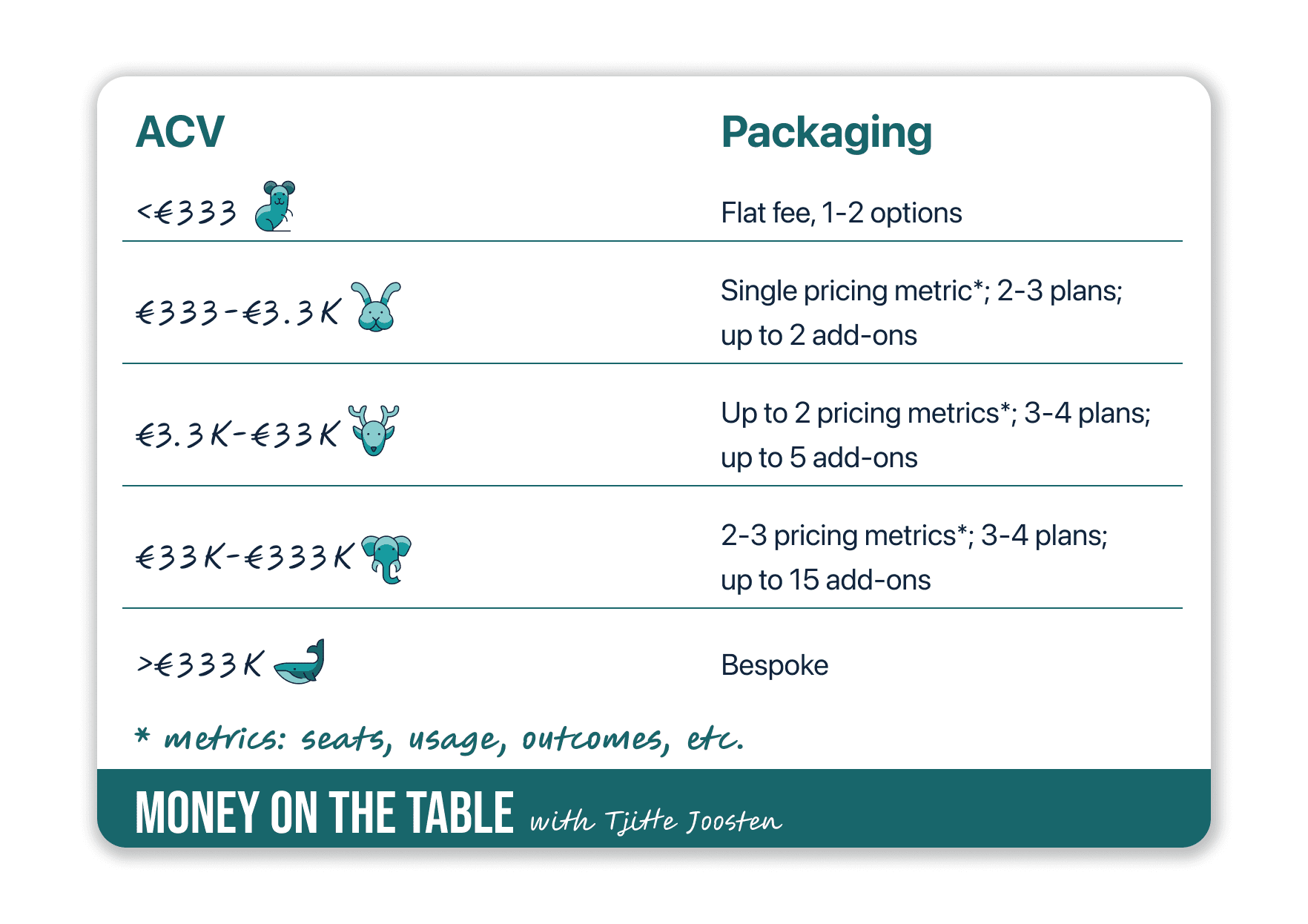
If you think determining the price point for your solution is a challenge, wait till you try to configure the perfect packaging. How you charge is much more important than how much. That’s why I’ve created a cheatsheet for packaging in 2025–based on dozens of repackaging projects for startups and scaleups.
TL;DR
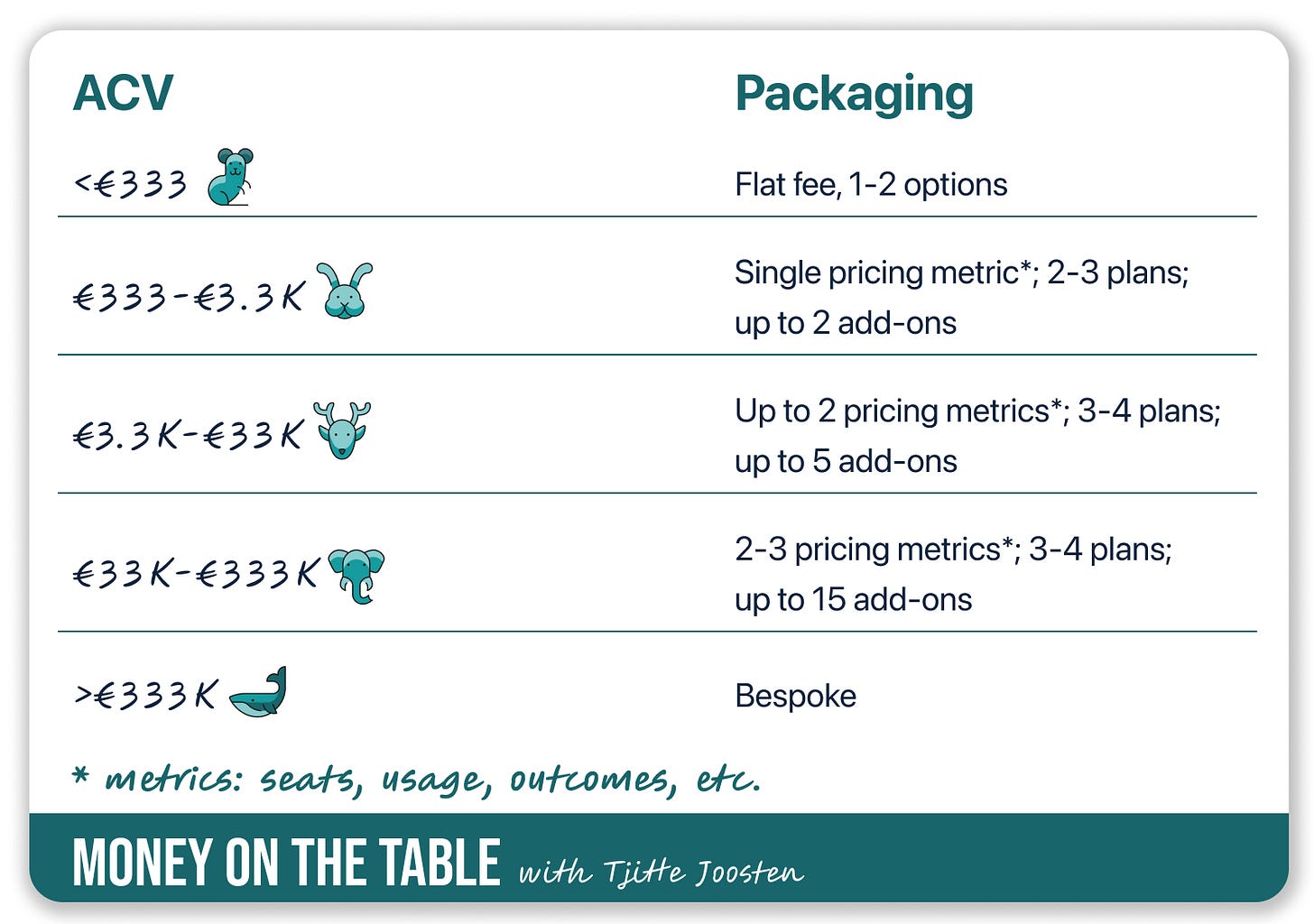
Your average annual contract size (ACV) dictates how creative your SaaS packaging should be. Simplistic pricing with large contracts generally results in aggressive discounting while complex pricing at consumer subscriptions will result in low conversions. The table below is my cheat sheet for SaaS packaging when dealing with 1-25M ARR companies.
👋 Hi, it’s Tjitte Joosten and welcome to Money on the Table, your newsletter for making sense of pricing and packaging. Subscribe to get posts like this delivered straight to your inbox.
The Creativity Curve
It’s a mistake to assume simple pricing is always the best option. Take Salesforce for example. Their pricing document is 60 pages!! You practically need a PhD to make sense of their pricing. And yet, nobody would dare to call the Columbus of SaaS a mediocre company.
So, if it’s not simplicity we should all be aiming for in packaging, what should be the measuring stick?
I believe it’s creativity. More specifically: as your contract size grows, so should the number of options and configurations in your packaging. And the curve is not linear as you can see below.
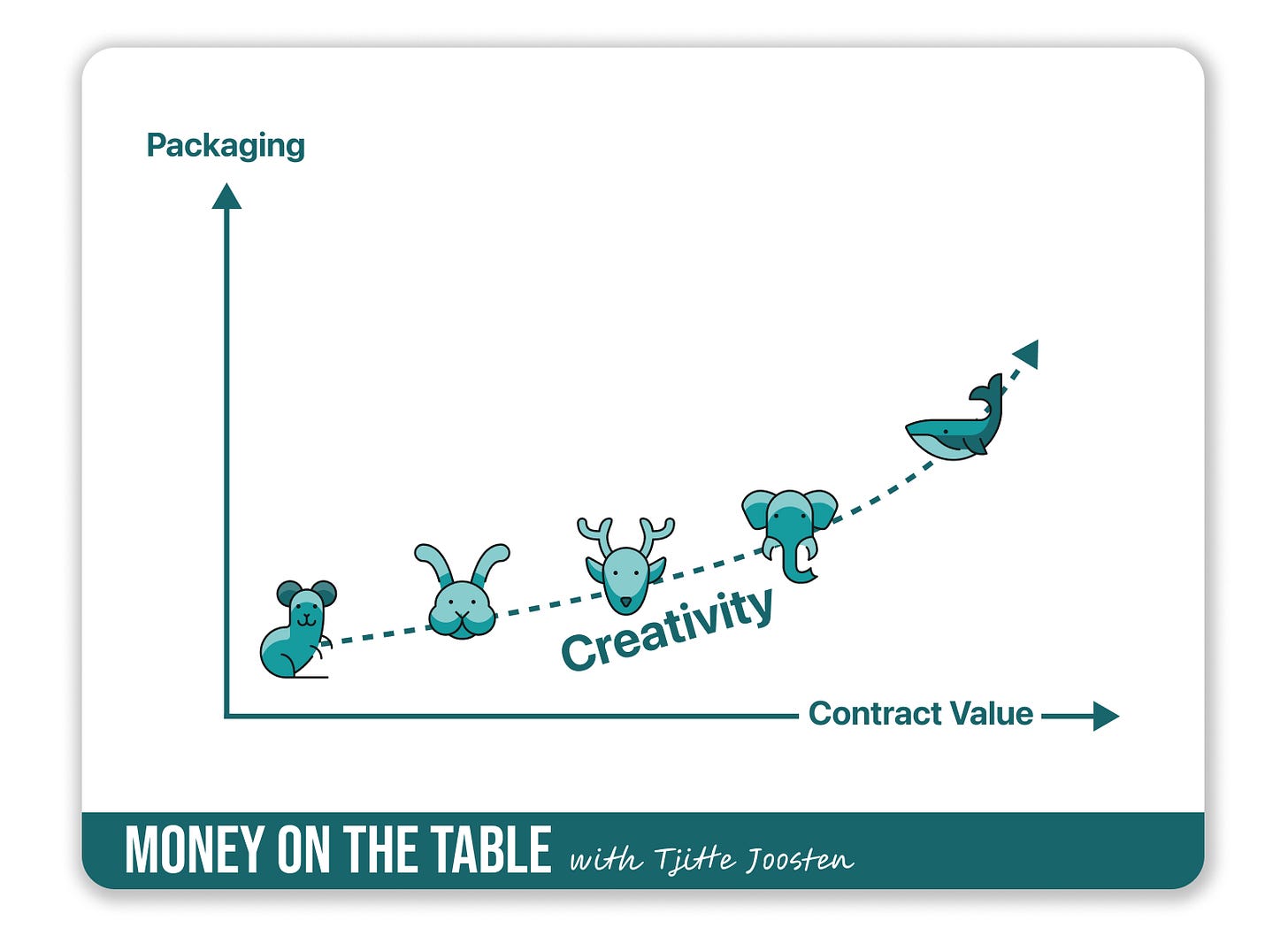
Packaging Creativity Curve
Why is that? Because as deals get bigger, more people get involved in the buying process. Each new stakeholder introduces a new set of requirements on top of the existing requirements. Luckily, these stakeholders also bring their own budgets.
When you’re buying a Spotify family account at $20/month, one sacrificial lamb in the family will probably take the hit.
Even if your startup switches to Google Suite at $2K/year, someone like the COO will just sign off on it.
However, when you’re purchasing a new CRM solution at $30K/year, it’s not just one person that signs off anymore. Marketing, Sales, Customer Support, and even the management team will each have to sign off. They each have different requirements, but they also have their own budgets.
That’s why CRM solutions like Hubspot or Salesforce don’t just pile everything onto a single line item that says $/user/month.
Instead, their packaging does the following:
(1) …differentiate between buyers: marketing, sales, customer support, and management.
(2) …offer multiple tiers to match the sophistication of the buyer as they scale.
(3) …offer add-ons to serve specific needs (regardless of sophistication).
(4) …different pricing mechanics that rhyme with the value creation (e.g., seat-based for sales, or # of contacts for marketing).
This way, that $30K quote will explain which stakeholder pays for what and why.
The single most important question in packaging is: Does your packaging explain what someone is paying for, who should pay for it, and how it scales? If not, go back to the drawing board.
The Packaging Cheat Sheet
Now that I’ve explained why it’s important to introduce more creativity in your packaging as your contract size grows, it’s time for my packaging cheat sheet. Below is the mental model I use when evaluating packaging of my SaaS clients.
1️⃣ Contracts up to €333 annually
1-2 plans with flat fees
Annual payment discount
Buyers need to be able to convert on your pricing page without human interaction.
2️⃣ Contracts between €333 and €3.3K annually
Single pricing metric (seats, usage, outcome, etc.)
2-3 tiers to pick from, may use one plan to make others more attractive
1-2 add-ons and annual payment discount
Majority of buyers should convert on your pricing page. Offer demos for highest tier and share quote in call.
3️⃣ Contracts between €3.3K and €33K annually
May combine 2 pricing metrics (seats, usage, outcome, etc.)
3-4 plans and exclude price from highest tier
Up to 5 add-ons and compatible for every tier
Optional: multi-year contract discounts
You will have face time with every client. This enables you to start customising quotes. Allow for flexibility and price differentiation based on needs or size.
4️⃣ Contracts between €33K and €333K annually
Up to 3 pricing metrics (seats, usage, outcome, etc.)
3-4 plans without pricing indications
Consider including cost-coverage (e.g. cloud usage)
Catalog of add-ons
You’re dealing with multiple budget owners. Make it easy for each budget owner to pick up their part of the bill by breaking up the proposal into clearly defined line items.
5️⃣ Contracts beyond €333K annually
Bespoke: tailored pricing for each client
Include fees they’re accustomed to paying
Charge for value you can directly influence
Enterprise buyers at this scale expect extreme flexibility in how your pricing is structured. Make sure to monetise your value creation and include structural cost in your proposal.
Every company’s different, but this model has consistently and reliably told me when to dig deeper–or move on.
TL;DR - The Takeaway
Your average annual contract size (ACV) dictates how creative your SaaS packaging should be. Ask yourself: does our packaging explain what our client is paying for, who should pay for it, and how it scales? If not, go back to the drawing board.
Want to learn more about SaaS pricing and packaging? Subscribe to Money on the Table or schedule a call at https://revfixr.com/contact

Tjitte Joosten is the Founder of RevFixr, the one-stop shop for better monetisation of your customer base. RevFixr turns pricing into your biggest growth lever. Prior to founding RevFixr, Tjitte was responsible for the commercial strategy and operations at tech companies like Docfield and Experfy.